The plan.
This was my fifth marathon (fourth official race, third Gold Coast Marathon) so I was no stranger to either the distance or the event. I had a decent sense of the plan going in so below summarises basically the differences between last year and this.
I’d also run the Brisbane Half Marathon in early June 2026 so I had at least that fresh remind of what’s different on race day — crowds, hydration, the extra little boost from the thousands of other runners.
The goal:
Sub four hours. “Anything with a three in front of it.”
PB (from 2025):
4:03:03.
The differences this year vs. last year:
- I’ve been training with Runna instead of a Google Doc. I’ve run 756.9 kilometres so far this year vs. ~700 kilometres before the Gold Coast Marathon last year. Not as significant a difference as I expected.
- I’ve been training with Maurten gels, specifically 160s every seven kilometres on long runs. I ran last year with my first proper gel at 32km and a caffeine gel at 35km.
- I’ve also been doing much more gym cardio than last year through Fitstop Nundah. I’m doing probably less consistent purely strength training but I am at least more consistent with the gym in general.
- I’ve also been playing roughly weekly indoor soccer this year on Thursdays with a crew so explosive cardio is much more a part of my regular routine than it has been.
While I’ve probably been running less volume (last year I was probably running three-four times a week vs. this year would have been closer to two-three times a week) each of those runs was for increased distance. The thinking was — well, a justification sort of later into training — that I was getting the cardio in elsewhere to give me general endurance. That I was getting the distance on the legs so I was better prepared for the enemy at 32 kilometres:
My own head.
The other difference from this year vs. last year:
- I didn’t have the flu when I ran last year.
This was the curveball right at the finish, sickness coming home, probably because my simple work from home life means that I leave the house to run, to go to the gym, or to go to the pub to see a friend (or just to go to the pub) so my immune system is not what it used to be. Maybe Jess brought something home from her school holiday programs but it doesn’t matter. I got sick.
I was smacking out cold and flu tablets and Armaforce in the week leading up to the race but I was probably a bit too casual about my food during this period too. Maybe more chicken soup more often but I think I got the carb load balance right with a new routine called — don’t laugh — regularly eating breakfast… which was mostly Weet Bix. I usually do four. How many do you do?
What I was more concerned about ahead of the race, sick, was my cough. Every morning it was deep in my chest, breaking something down. We got some Duro-Tuss on the Friday before race day and I was having it nightly and taking it and that was helping to a degree. I had it the night of the race and on the morning of I had two cold and flu tablets but no Armaforce. I run on an empty stomach for race days like that. I don’t eat that early and I tend not to eat close to runs. As they say: nothing new.
Otherwise the rest of the logistics was the same as last year: same hotel, same tram stop to the Broadwater Parklands, same starting group. The goal was to shave off fifteen minutes.
During training I’d seen a fair bit of discussion in Instagram comments sections on Reels about running that Runna was pretty optimistic about race day paces. By race day it was suggesting I could hit somewhere between 3:38:00 and 3:45:00. I’d be stoked with those. And happy with anything with a three in front. And I would have been, in truth, pretty frustrated in myself with anything with a four in front.
Sick, I wasn’t sure what that number would be but I was thinking I would aim at a 5:20 pace for as long as possible. I know the idea should not have been to bank time, to run a positive split, and that I should have been aiming for a negative split if possible, but I knew that my heart rate would be a problem and I was concerned about overheating. I run hot as it is and with a flu over the top I was considering changing the hydration strategy re: the water/electrolytes balance.
Roughly, the overall race plan was this:
- 5.40am arrival time at the Broadwater Parklands for a 6.05am marshall from Start Zone B, departing at 6.25am.
- Come out of the gate at about 5:20 per kilometre for as long as possible (ideally the full 42.195 kilometres as I’d done a thirty-two-ish-er to this pace during training).
- 160 gram Maurten gel at 7 kilometres, 14 kilometres, 21 kilometres, and 28 kilometres.
- See Jess and Dan and Rychelle and Mum and Dad at kilometres 14, 21, and 32.
- AirPods out halfway to let them charge for a bit.
- 100 gram caffeine Maurten gel at 35 kilometres.
- Overcome the head noise I’ve fought between 32km and 35km every other year.
- Go sub-four.
Race day.
Sick — still, a constant reminder — I snoozed my alarm for ten minutes which was a good preview into how the rest of the morning would go. I drank water, took my tablets, got dressed, and we left the door with dramas but we were starting to realise we were tight on time.
The tram fills up at Broadbeach going north and we got some space thankfully before we got Northern Line crushed into the carriage with the swell of other runners who were staying closer to the Parklands.
We arrived to longer toilet lines than last year and queued and also didn’t have any dramas here except that time was tight. I jumped into the race chute at what I thought was Start Zone B… until it started moving and I realised I was in front of the 3:40 pacers. And that we were due to start ten minutes earlier. Mum and Dad were trying to cross the Gold Coast Highway to see me off but they were going to miss me. At least: I was going to miss them. They saw me start at 6.15am, a little early, but that didn’t matter.
The idea was to come out strong.
That happened. Hit and held a bit below 5:20 pretty quickly but what I was then concerned was my heart rate. I basically hit 170 bpm during the second kilometre and it never did come down. I thought at the time that this was unexpected but in hindsight looking at my heart rates for that kind of pace that’s pretty fine. I did just expect that a taper and race day would get that a bit further down though I don’t know what to make of being sick in that midst and how much it affected my heart?
I do suspect that my heart rate was between 5 and 10 beats per minute too fast for most of the race. That’s what I told Rychelle at kilometre 14 when she jumped along Hedges Avenue and followed ahead of me for a bit for an update.
Because the thing about this race vs. last year is that I don’t really remember a lot of it. I remember just feeling pretty bad basically the whole time. There was the crush of 3:40:00 runners that passed me about kilometre five which was as dense as the crowd got.
The first Thing to write about I guess was the change in hydration strategy on the course: At kilometre 16 I slowed right down to hit a water station for two waters just to keep my fluids up on the warm day with what I was afraid would develop with exhaustion into a fever. And — spoilers — some heat stroke. Healthy, the goal was to only hit one water about here and then start on the electrolytes with the Gatorade Jess was going to give me at 21 kilometres.
That went just fine but I was tunneled right in: I saw Dan had a sign that I didn’t know about and I didn’t even try to read it. I was just wanted the Gatorade. I saw there was a third person on the roadside with Jess and Dan. I only realised later that was Dad.
I was okay from there, with the Gatorade, through to kilometre 28km when I actually stopped and walked at the hydration station to put two waters away without spillage, a brief respite to get my heart rate down a few beats if it would go — and it did — and to make sure I had, as above, the fluids.
I repeated this stop and walk strategy in the back half a lot more than I expected but the tradeoff to my mind was finishing vs. not finishing. Because I just felt so bad. Not in, like, an ‘I’m running a marathon and we’re nearly at the end’ way but in, like, a ‘Please give me a sick note for this kind of thing in future, thanks’ way. I did this for aid stations at 31, 34, 37, and 40 kilometres. But otherwise I kept running the whole time.
I did change my nutrition plan on the fly a bit too: I had my caffeine gel at 28 kilometres and skipped the 35 kilometre gel. With the extra water and the gels and the cold and flu tablets from earlier and the sickness my stomach was getting a bit comfortable. I have a zero percent tolerance for shitting myself at all times and I had a sense by 30 kilometres that I was on pace for a sub-four but I wasn’t sure by how much. I didn’t want to risk it.
The key highlight, even though I felt like trash in ways unrelated to the actual marathon undertaking, is that the hard parts this year felt much less hard than those same parts in previous years. From 35 to 41.2 kilometres was difficult, sure, but much less arduous, and that’s partly just knowing better what to expect at those distances plus I had the nutrition in the bag.
I had Runna in my ear from kilometre 31 telling me to “Speed up slightly. Current pace: 5:40something. Target pace: 5:20.” I was happy to hold there. And maybe I shouldn’t have been? Maybe I should have pushed harder, really left absolutely everything behind.
Because it’s a funny one: I love doing this. I love the process of training for hard things, of achieving them, getting them done, wearing the medal, celebrating. And I love the training runs too. I love what it does to me mentally, how much more capable I feel, but there is also some sort of appreciation that’s innate that suggests that: this is not the be all and end all.
The difference for me between 3:45:00 and, say, 3:50:00 did not feel significant. So I let my pace drift, tried to actually enjoy the end of it for what it was, even feeling under the weather and not feeling great and not having that bit left in reserve for what I feel like is a fast final kilometre — though I did manage to do kilometre 42 at 5:28 per kilometre again. And only two kilometres — 38 at 6:12 and 41 at 6:04 — at over-six-minute paces.
This year I started my watch as I crossed the start line. I’d seen the 3:40:00 pacers cross the bridge at Runaway Bay heading back home as I was going out towards the final turnaround. I knew I was going to have a time I liked.
And I do like it.
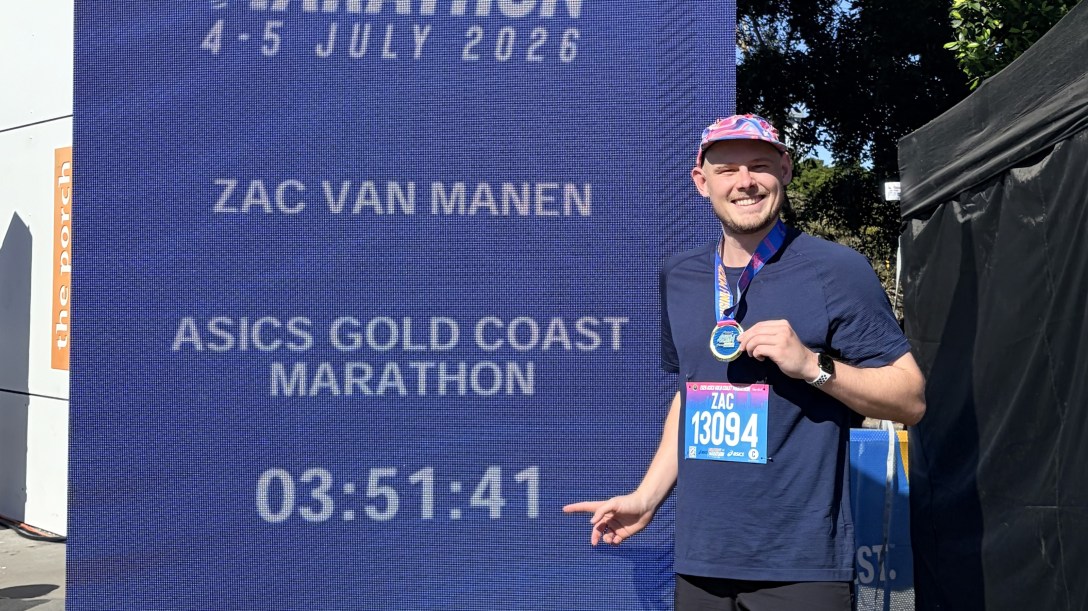
3:51:41.
I think illness cost me at least five minutes so I would love to see a 3:45:00 if I ever do the Gold Coast Marathon again… because now that I’ve done it sub-four, with not really a desire to get radically faster, what’s next? I don’t want to progressively overload a marathon training plan down to 3:30:00 or something. Sub-four is good and I like the idea of running one marathon every year below four hours for as many years as I can.
I’ll run Sydney again soon and I would love to sub-four it but these last two weeks of recovery have been much harder than I expected. Still sick to a degree and all my exercise — except for a short, easy run today of 6.5 kilometres at a 6:05 pace — has been tremendously hard. But I will get hill sprints and so on into rotation because the elevation is the change at Sydney. I will be well for it, prepared, nutrition dialled, more mileage between the two races than last year, and I would love to see a sub-four there.
Won’t be unhappy if I don’t. Just set a new PB there and we’ll call it a good day.
And if I don’t get it maybe that’s the target next year — third time’s a charm — but it is a ballot entry. I might not get in next year. And if I miss the target and don’t get in next year, what then? That’s a good question.
Maybe Rome beckons. Maybe Queenstown. We’ll see. And the target there will be, I know, sub-four. Capable. Possible.
Repeatable.
In sickness and in health.
Notes on Runna.
Opting to use Runna this year was pretty different and it was definitely much better at forcing me to do speedwork than I would otherwise have been. At least: it was better at getting me below five-minute paces per kilometre for bursts. The closest thing I’ve had to “structured training” was telling myself:
“Marathon pace is X, go run X for as long as you can.”
A simple strategy that nearly got me there in 2025 I suppose. But I did want to mix it up this year because I didn’t want a repeat of crossing the 2025 finish line unsure of my chip time because I a) didn’t notice the clock time when I crossed the start line and b) started Strava tracking (on my phone, not my Apple Watch) when my group started to move instead of when I crossed the start line.
So I signed up to Runna expecting that it would structure my runs better, push me a bit harder, and get better results overall. I have the feeling that worked overall but I missed something like 15% of my runs which is a bit higher than I’d have liked.
I’m using Runna again for the Sydney Marathon in a few weeks and I’ll use it next year too for training for whatever marathon I end up running. Will I use it between, say, September and February? Not sure.
Discover more from Zac van Manen
Subscribe to get the latest posts sent to your email.


[…] there wasn’t an absurd difference in the training distances between Gold Coast 2025 and Gold Coast 2026. Like 50 kilometres or something off the top of my head, out of like 750 kilometres total, so not […]
LikeLike